Banner, Pennant or Scarf: Three Ways to Mark a Sporting Gathering
Choose a banner, pennant or scarf for a sporting gathering by matching its scale, display and afterlife to the occasion and the people marking it.
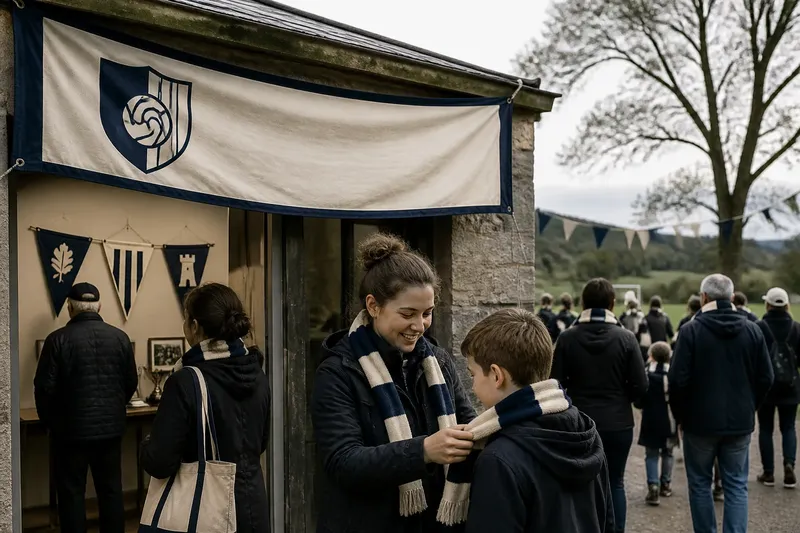
A banner, pennant or scarf can mark the same sporting gathering, but each asks to be seen in a different way. The choice shapes not only the occasion’s look, but also what people can carry home and remember. A sporting banner makes a public statement; a pennant gives that statement a more focused form; a scarf turns it into something worn and shared.
These are not fixed rules, and no object belongs to only one kind of event. Their different strengths lie in scale, movement and use. Thinking through those qualities helps a group choose an object that suits the gathering rather than simply decorating it.
What does each object make visible?
A banner is the clearest choice when a gathering needs a visible marker across a broad space. It can carry a name, emblem, place or short message, and its width makes it legible from a distance. Hung at an entrance or held aloft, it can signal that an ordinary area has become a meeting place for the occasion.
A pennant is narrower and often tapered, so it has a more pointed, directional presence. It works well as a display object: on a wall, above a table or in a line with other pennants. Its modest shape lends itself to a simple mark or a pair of colours. Unlike a large banner, it can make a small corner feel deliberately associated with the event.
A scarf is a sign that moves with its owner. It can be worn, held up, passed between people or folded away. That portability gives it a personal quality, even when many people wear matching ones. It is less suited to naming a distant focal point than a banner, but more suited to letting individuals carry the occasion through the day.
Those roles overlap. A scarf can hang as a display, and a pennant can be carried. The useful distinction is not what an object is allowed to do, but what it does most readily: mark a shared space, punctuate a display or travel with a person.
How should the gathering shape the choice?
Start with the setting. In a large open area, a banner’s broad face can provide a clear visual centre. In a room or sheltered meeting place, a pennant may be easier to position without dominating the surroundings. If people will move between places, a scarf is naturally easier to carry and keep close.
Then consider the gathering’s social shape. A banner often speaks for a group as a whole: it presents a common name or purpose to everyone who arrives. A pennant can represent a smaller unit, a particular occasion or a collection of occasions. A scarf offers a more individual form of participation, while still creating a shared appearance when worn together.
There is also a difference in how people encounter each object. A banner is usually noticed before it is approached. A pennant invites a closer look at its emblem or wording. A scarf becomes part of the crowd’s movement, visible in gestures as well as in stillness. The best choice depends on whether the occasion needs a landmark, a detail to discover or a sign people can animate themselves.
Imagine a community gathering that begins in a hall and then moves outdoors. The organisers want to identify the meeting point, make a small display indoors and give participants something they can carry. They could use a banner at the entrance, a pennant on the display wall and scarves for those who want to wear one. If only one object is suitable, the hall-to-outdoors journey points towards the scarf; if finding the meeting point matters most, the banner may serve better.
What do material and design change?
Material affects how an object hangs, folds and feels. A banner needs enough body to display its design clearly, but it must also suit the place where it will be hung or held. A pennant’s shape can keep a simple design readable, while a scarf’s soft fabric makes it comfortable to fold and wear. A visual idea that looks crisp on a flat banner may need simplifying for a narrow pennant or a fabric that gathers around the neck.
Keep the design’s purpose in view. If the object must identify the gathering from across a space, a short word or bold emblem is easier to read than a dense block of text. If it is mainly a keepsake, smaller details may reward a close look. A scarf also has two visible faces in use: its design should remain recognisable when draped, folded or lifted, not only when laid flat.
Colour can connect the objects without making them identical. A shared palette gives a banner, pennant and scarf a family resemblance; a different arrangement can signal their separate roles. For example, a banner might carry the full name, while a pennant uses one emblem and the scarf repeats the palette. That division keeps each object legible instead of asking all three to carry the same information.
Before settling a design, look at the surface where it will appear. A pale emblem may disappear against a light wall; fine lettering may be hard to pick out in a moving crowd. A paper mock-up, or a simple digital layout viewed at a smaller size, can reveal when a mark is too crowded. The aim is not decoration for its own sake, but a design that still makes sense in its intended setting.
What can happen to each object after the event?
A banner’s afterlife is often tied to display. It may be folded and stored, brought out for another gathering or kept as a record of a particular occasion. Its size makes storage and future hanging part of the decision from the start. If no suitable place exists, a smaller format may be more practical than an object that is difficult to put away.
A pennant can sit comfortably among other keepsakes. Its shape lends itself to a small display, and a series can show recurring occasions or different parts of a shared sporting identity. That sequence does not need to be planned as a collection in advance; a pennant can also stand alone as a reminder of one gathering.
A scarf’s afterlife is built around use or personal keeping. Someone may wear it again, lend it to a friend or store it with other sporting mementos. That flexibility can make it an appealing keepsake, though a design meant for regular wear should remain pleasant to handle and easy to coordinate with ordinary clothing. A scarf that is treated only as an object for display may instead be folded or framed, depending on its material and condition.
The choice of keepsake also shapes what is remembered. A banner is likely to recall the gathering as a collective scene. A pennant can bring back a particular emblem or occasion. A scarf may call to mind the people who wore or shared it. These associations are not exclusive, but they suggest different ways for an object to carry memory beyond the day itself.
Which object suits a particular need?
Use these questions to narrow the choice:
- Does the gathering need a visible meeting point? Consider a banner, especially where people need to recognise a shared location.
- Is the object mainly for a compact display? A pennant can offer a clear emblem without taking up much wall space.
- Will participants move between places? A scarf is easier to carry, wear or fold away as plans change.
- Should the design speak for the whole group? A banner can present a common name or message; a scarf can let individuals show their connection.
- Will the object be kept alongside other memorabilia? A pennant can be easy to arrange with other small objects, while a scarf suits a personal collection.
- Is the message too detailed for a glance? Simplify it, or choose an object that will be seen at close range.
These are prompts rather than a ranking. A gathering may call for one object, or several with distinct jobs. The decision becomes clearer when each object has a reason to be there: the banner identifies, the pennant marks a detail and the scarf travels with its wearer.
What do readers often ask about banners, pennants and scarves?
Is a pennant just a smaller banner?
Size alone does not explain the difference. A pennant’s tapered shape and compact display often make it feel like a focused emblem, while a banner’s broader surface tends to work as a prominent sign.
Can a scarf serve as a keepsake if it is worn?
Yes. A keepsake does not have to remain untouched; wearing it can make it part of repeated gatherings and everyday memory. Someone who prefers preservation can fold it away or display it instead.
Should all three objects use the same design?
They can share colours or a central emblem without repeating every detail. A short, clear mark on each object may be more effective than squeezing the same long wording onto surfaces with different shapes.
Which object is easiest to carry?
A scarf is usually the most natural object to wear or fold into a bag. A pennant can be portable too, but its format is more often chosen for display; a banner’s size and handling depend on its material and intended use.
How can the choice feel deliberate rather than decorative?
Give the object a clear job before deciding its design. Ask where it will appear, who is meant to notice or use it, and what should remain with people afterwards. If the answers point in different directions, that is a reason to choose complementary objects rather than force one to do everything.
A banner, pennant or scarf can all mark a sporting gathering, but their meanings grow through use: where they are placed, who carries them and whether they return at another occasion. Choose the form that makes the gathering easiest to recognise and easiest to remember. That practical fit is what turns a sporting object into a sign of belonging.