Why the Pavilion Became More Than a Place to Watch
See how a pavilion’s position beside the field shapes gathering, shared attention and local memory, and learn to read its relationship with play.
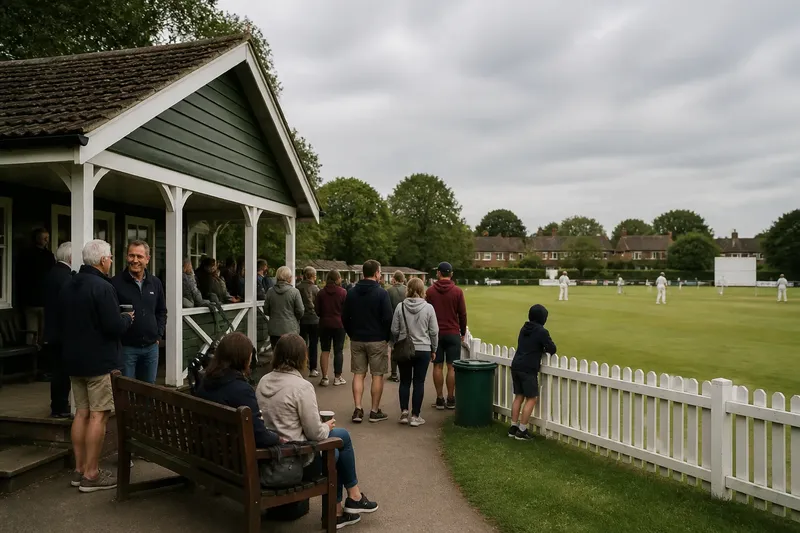
A pavilion can turn the edge of a playing field into a meeting place. To understand why a pavilion became more than a place to watch, start with where people enter, pause and face: its social meaning is written into the ground around it as much as into its walls.
This is a way to read a pavilion as part of a sporting community, not simply as architecture. Walk from the approach to the field, notice how spectators and players use the space, then consider what the building allows people to share. You do not need access to the interior or a formal club history; ordinary details can reveal how gathering and play sit together.
Where does the pavilion meet the field?
Begin at the field’s edge and locate the pavilion in relation to the playing area. Is it centred on the action, set behind one boundary, or placed to one side? Note what lies between the building and the field: a path, a strip of grass, a low fence, a terrace or an open stretch where people can stop.
That interval matters. A building close to the boundary may make watching feel immediate, while a wider apron can hold people who want to talk without standing in the players’ way. Neither arrangement has a single meaning. Look at how the space works on the day you visit, and distinguish what you can observe from what you are inferring about its past.
Sketch the arrangement in a notebook if it helps. A few marks for the pavilion, boundary, entrances and main path are enough. The aim is not an architectural plan; it is to see whether the building faces the game, the approach, or both.
Which routes bring people together?
Now walk the public approach to the pavilion. Notice where a newcomer naturally slows down and where arriving groups can wait without blocking a gate or crossing active play. Look for paths worn into the grass, gates that funnel movement, and places where a clear view first opens up.
Routes often explain a pavilion’s role more plainly than a plaque does. If spectators arriving from different directions pass the same doorway or open patch, that point can become an informal place to meet. If the entrance leads directly into a viewing area, arrival and watching may happen in one continuous movement.
Picture a small village cricket field where the pavilion door opens towards the boundary and a path from the car park reaches the same patch of ground. A family arriving to watch might pause there to greet friends before finding a seat; the observable result is a shared meeting point beside the game, rather than a queue that stays separate from it. The imagined scene is useful because it links a route to an ordinary social action without claiming that every pavilion works this way.
What can you see from its edge?
Stand in public areas where a spectator might reasonably pause, and follow the sightlines. Can someone keep an eye on play while speaking to another person? Does a doorway frame the field, or does a wall conceal part of it? Are there seats, a veranda, a window or a sheltered edge that supports watching in different weather?
These details show how the pavilion can join conversation to attention. A viewer need not choose between being with other people and following the match if the space keeps both within reach. Yet a blind corner or a building turned away from the field may suggest a different emphasis, such as serving as a changing or administrative space first.
Do not treat one visit as a complete account. A quiet practice session, a busy fixture and a closed day can make the same place feel quite different. Record the conditions briefly—where people are allowed, what is open, and what activity is under way—so you do not mistake a temporary arrangement for a permanent custom.
Who uses the space, and how?
Watch patterns without turning people into exhibits. Notice whether players, officials, families and older spectators use distinct entrances or share the same threshold. See whether someone remains close to the field while others gather under cover, and whether people move between those positions as play changes.
Small acts can make the pavilion a social landmark: greeting an arriving teammate, waiting for a child to finish, or turning towards the field when play resumes. These are not proof of a fixed tradition, but they show how the building’s position can support repeated encounters. If you are speaking with club members, ask open questions such as, “Where do people usually meet before play?” Let them describe the practice rather than supplying an answer for them.
Keep public access and privacy in mind. A club ground may be private even when it looks open, and players may be concentrating. Stay in permitted areas, avoid photographing people without consent, and do not interrupt a fixture to ask questions. Where access or permitted use depends on the club, follow its stated rules.
How can you tell whether the pavilion still anchors a gathering?
Compare the building’s physical arrangement with what people actually do. A veranda facing the field suggests an opportunity to watch, but a view alone cannot tell you whether anyone gathers there. Look for use: people choosing that side, returning to the same meeting point, or talking while keeping the game in sight.
Also notice the limits. A pavilion can remain a recognised landmark even if its rooms are locked, its entrance has changed, or spectators now gather elsewhere. The building’s location may still orient visitors—“meet by the pavilion” can remain meaningful—while the social habits around it shift. Describe both facts rather than treating the structure as an untouched symbol of community.
What should you look for when reading a pavilion?
Why are pavilions often beside the boundary?
That position can bring spectators close to play while keeping a building available for changing, storing equipment or organising a fixture. The exact arrangement depends on the sport, field and local use, so read the boundary and entrances together.
What makes a pavilion a meeting point?
A recognisable location, an accessible approach and room to pause can help people arrange to meet there. Look for evidence in how visitors use the space, rather than assuming the building’s appearance tells the whole story.
Can a pavilion matter if it is closed?
Yes: its position can still help people identify the ground or explain where a match took place. But a closed building offers less evidence about current gathering, so separate its landmark role from observed use.
How can I record what I notice?
Make a simple field sketch, note the routes and sightlines, and write down the conditions during your visit. If you add local memories later, mark who shared them and keep recollection distinct from what you saw yourself.
What makes the pavilion part of the sporting story?
Bring your observations together by tracing one ordinary sequence: where someone arrives, where they can pause, what they can see, and how they move between conversation and the match. That sequence connects the pavilion’s placement to the lived rhythm of the ground without claiming that every visitor experiences it alike.
If you are writing about a particular club, keep the physical description and the community’s account in view side by side. A path or doorway can explain how a gathering is possible; a player, volunteer or spectator can explain what it means to them. The strongest account of why a pavilion became more than a place to watch leaves room for both: the field remains the focus, while the building gives people a shared edge from which to meet it.