The Club Photograph as a Record of Who Belonged
A club photograph records more than faces: learn to read its poses, clothing and absences without mistaking one group portrait for the whole membership.
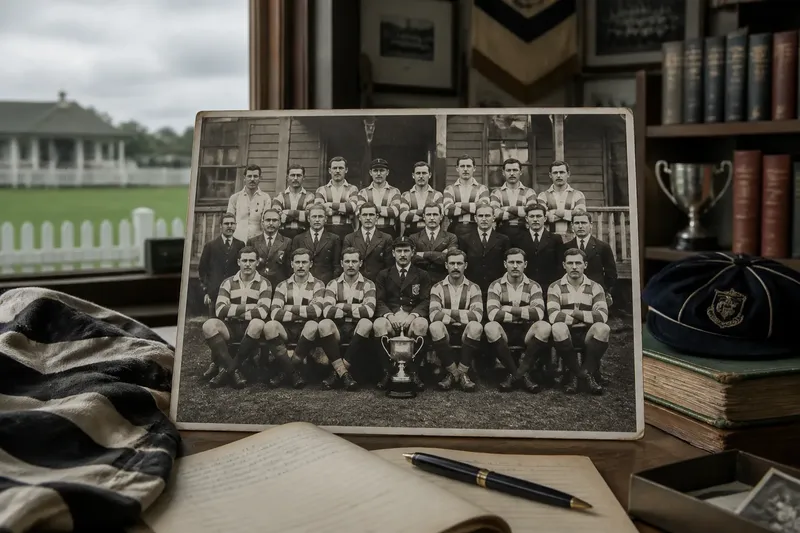
A club photograph records who stood together, but not everyone who belonged. Read its poses, clothing and repeated group portraits as evidence of a changing membership: a useful record, never a complete roll call. A row of players in matching shirts may show one side of club life; the people who washed those shirts, kept the accounts or watched from the boundary might be nowhere in frame.
What can a club photograph tell us about membership?
It can show who was visible, how the club presented itself and which roles its members thought worth recording. The arrangement offers clues: players may sit in the front row, officials occupy the centre, and younger members stand at the edges. A captain’s position or a shared badge can signal status and affiliation.
Those clues need careful wording. A photograph can support a claim that certain people were pictured together, in particular clothing, at an identified occasion. It cannot, by itself, establish everyone’s formal membership, explain why someone was absent or reveal how each person felt about the club.
Look for the image’s setting and occasion before interpreting it. A team portrait, a junior group, a committee photograph and a gathering after a match each represent a different slice of club life. A posed image can be especially revealing about the club’s public face, but it is still a selection made for a purpose.
Why do poses and clothing matter?
Pose and dress make the photograph legible to its own time. A uniform may distinguish playing members from officials; a jacket, tie or cap may mark a formal occasion. People who are seated, standing or placed beside a prominent figure may have been arranged according to age, role or status. Treat these as questions to investigate, not automatic proof of rank.
Clothing can also record change. Compare the cut, badges and consistency of kit across a series, while allowing for differences in what a club could provide and what members supplied themselves. A mismatch does not necessarily mean someone was an outsider. It might reflect the occasion, a borrowed garment or a practical choice.
Names, handwritten captions and marks on the back can help connect faces to records, but a caption may have been added later. Keep a distinction between what is visible, what the inscription claims and what another source confirms. That distinction protects a vivid image from carrying more certainty than it can bear.
How do repeated photographs reveal change?
Repeated group photographs let you compare who appears, who is placed centrally and what kinds of roles are represented. They can suggest shifts in age groups, participation or the club’s preferred image of itself. The comparison works best when the photographs have a known or plausible relationship, such as annual team portraits or images from the same event.
Imagine a local rowing club has three portraits from different seasons. In the earliest, the visible group is mostly adult rowers; a later image includes a junior crew, and a subsequent committee portrait shows women in named administrative roles. The sequence could help a club ask when those roles became visible in its records. It would not establish when participation began: minutes, membership lists or oral accounts might tell a different part of the story.
Record each image separately before comparing them. Note its title or inscription, likely date, photographer if known, occasion, names and the source of each identification. Mark uncertain names as uncertain. A simple spreadsheet can keep these details beside a stable file name, while a scan preserves the image without handling the original repeatedly.
How should you identify people and describe gaps?
Start with names written on the photograph or supplied by a person who knows the group. Then check club programmes, minute books, team sheets, local newspapers or other photographs. A second source can confirm an identification, but disagreement is information too; record it rather than silently choosing the neatest answer.
When a face remains unknown, describe what can be seen without inventing a biography: “unidentified player beside the goalkeeper” is more useful than a confident guess. If people are identifiable and the photograph will be shared publicly, consider consent and privacy, especially for images involving children or people who may not wish to be named. Local rules and archive policies can affect what is appropriate.
Absence deserves the same care. Someone missing from a portrait may have been injured, working, unavailable, excluded or simply outside the photographer’s frame. Unless another source explains it, say only that the person does not appear in that image. The photograph records a moment of visibility, not a verdict on belonging.
What questions should you ask before drawing conclusions?
Who arranged the group?
The photographer, club officers or participants may have shaped the pose for different reasons. Look for clues in the occasion, the setting and any accompanying caption before treating the arrangement as a formal hierarchy.
Who is named, and who remains unidentified?
Compare inscriptions with team sheets, programmes and club records, noting where an identification comes from. Keep unresolved names visible in the catalogue rather than filling gaps with guesses.
What does this photograph leave out?
Ask which ages, roles or kinds of participation are not shown, then look for other records that might cover them. The missing group is a prompt for further enquiry, not proof that those people were absent from club life.
Can the date and occasion be supported?
Clothing, venue details and familiar faces may narrow the possibilities, but they rarely settle a date alone. Compare the image with dated club material and label an uncertain date as approximate.
How can a club preserve the photograph’s context?
Keep the original safely stored and create a clear digital copy for routine access. Preserve the back as well as the front: stamps, pencil notes and fading captions can matter. Use a filename that identifies the collection and image, not a guess presented as fact, and keep a separate record of names, sources and uncertainties.
Invite members and former members to add identifications, but retain who supplied each one and when. Their memories can supply context that a formal archive lacks; they can also differ. Preserve those differences in the record rather than forcing a single story.
The club photograph is most valuable when treated as one voice among many. A carefully described portrait can show how membership was presented, who became visible and what questions remain. Pair it with lists, minutes and remembered experience, and the image becomes a stronger record precisely because its limits stay in view.